Sourcing Guides
Floating Shelf Not Level? Slot and Bracket Alignment QC
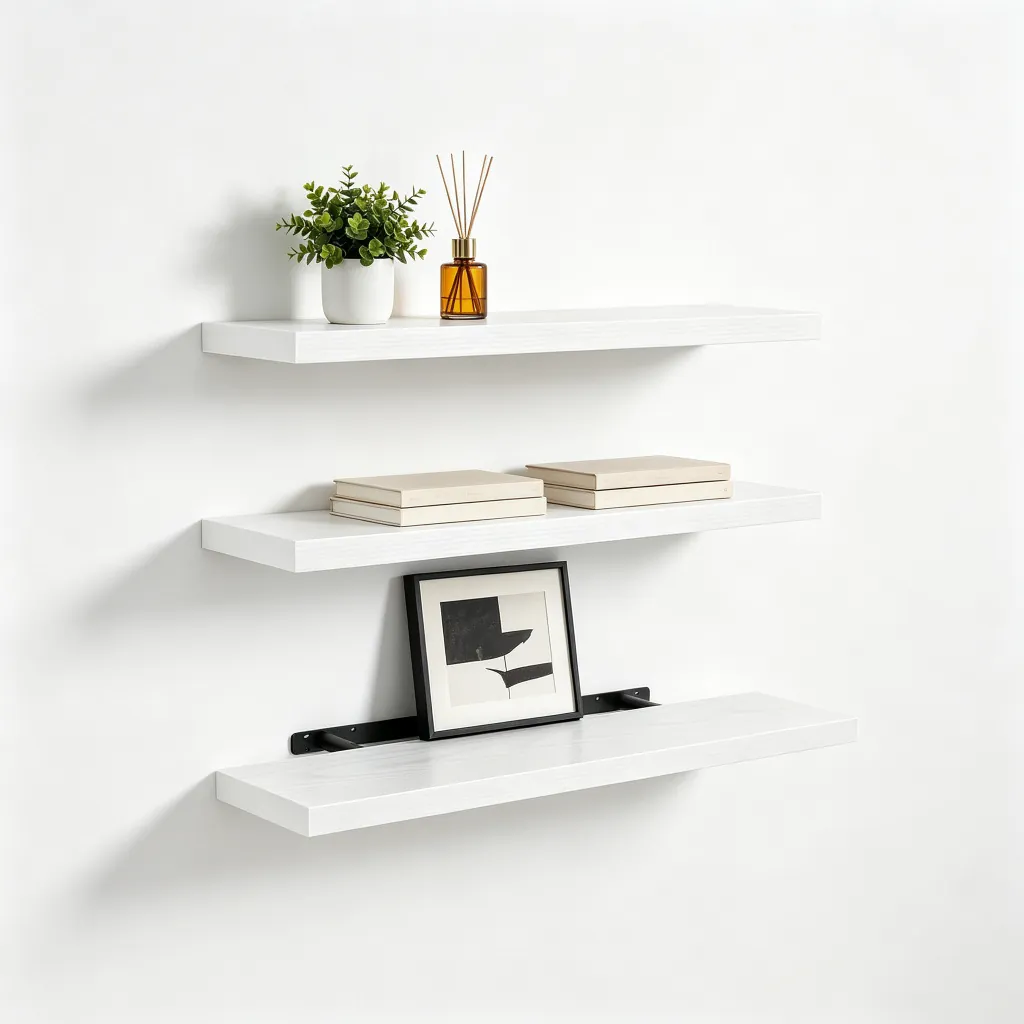
A board goes up on a Saturday afternoon. Screws driven, a quick check against the phone level, a row of books on top. It holds. Then someone steps back to the doorway and sees what the wall was hiding: one end of the board sits a finger's width lower than the other.
Installers and end customers keep describing versions of the same shelf. One that looked right until they stepped back and saw the tilt. One that leaned forward off the wall the next day — straight at bedtime, forward by breakfast. One where the screws chewed holes half an inch wide, because the anchor behind them never matched the wall.
We manufacture floating shelves in Xianju, Zhejiang, and we read complaints like these the way a machinist reads a rejected board: as a trail pointing back to the step that failed. A crooked shelf is rarely one mistake. There are three places it can start, and only one of them is the wall.
Cause One: The Slot — Alignment Is Machined In, Not Adjusted Later
Our main line is engineered-wood (MDF) floating shelves with a hidden steel rod bracket. The bracket carries the steel rods, the board carries the slots, and the board slides over the rods. That is the whole joint. Which means the slots are where alignment lives.
If a slot sits off its line, the board can only sit off its line. There is no adjustment afterwards. No screw to nudge, no shim that pulls a misplaced slot back to where it should be — the board has nowhere else to go.
The other thing about slots: the error travels. A deviation you cannot see on the bench shows up the moment the board meets the wall, because the board is long and the error multiplies along its length.
So slot alignment is our half of the problem, and it is decided where the slots are cut — before the board is finished, before it is packed, before it ever sees a wall. Section five shows the checks.
Cause Two: The Bracket on the Wall — Level, Holes, and the Anchor That Did Not Match
Even a perfect board goes up crooked if the bracket under it is wrong. Three things have to happen at the wall. The bracket has to go on level. The holes have to be drilled where the guide marks them. And the anchor has to suit the wall — wood, brick, drywall and cement each take a different fixing.
Skip that last one and you get the failure end customers describe with the most feeling: a screw driven into an anchor that does not match the wall. It grips, then it doesn't. It works loose, chews the hole oversized, and the bracket drops a fraction. The board itself is straight — lay it on a bench and it passes. On the wall it reads crooked, because the thing holding it has shifted, and the board follows the bracket.
That half of the problem belongs to whoever holds the drill. But how much help that person gets is decided by us, in the carton. More on that below.
Cause Three: The Wall — a Level Board on a Leaning Wall Still Reads Crooked
Walls are not always plumb. Older buildings settle, and fast fit-outs put partitions up in a hurry. Before blaming the shelf, put a level on the wall itself. If the wall leans, a bracket fixed true to that wall leans with it, and the board above reads crooked through no fault of its own. The honest fix in that case is to level the bracket to the room, not to the wall.
We list this cause so nobody chases the wrong suspect. A perfectly good board should not wear the blame for a wall it never touched.
The Factory QC Steps: Where Alignment Is Actually Decided
Bracket alignment is not rescued at the end of the line. It is decided at three points, in production order.
- The fixture check, at slot machining. The slots are checked against the same fixture the bracket is made to. Slot and rod are checked against each other, not against separate drawings. That matters more than it sounds: a slot made to one drawing and a rod made to another can each pass inspection on its own and still refuse to meet on the wall. Checking the pair against each other is what makes them meet.
- The sample fit check. Before a sample ships, we mount the sample board on its real bracket and check it with a level. A sample that has never been mounted proves nothing about alignment. It proves the board exists. Only a board that has gone onto its own bracket and been levelled tells you the slot and the rod agree.
- The pre-shipment spot check. Before the order closes, boards from the run are spot-checked against the bracket, and the hardware kit is counted into every carton — installation guide, level tool, and anchors for wood, brick, drywall and cement walls.
That is the chain: fixture, sample, spot check. The bracket side of this story — rods, plates, how the hardware is specified — is covered in our hardware and fit checklist. The boards these checks run on are the ones in our floating shelves range.
What the Carton Does for the Installer Half
Cause two ended with the half of the problem we cannot reach: the drill is in someone else's hands. The carton is how far our reach actually extends, and three things in it block the most common installer failures.
- A level tool. The bracket goes on level with the tool supplied — not with a phone app held at a bad angle, not with a borrowed spirit level of unknown temper. Level in, level out.
- A guide that marks where the holes go. Nobody drills by eye. The holes land where the bracket needs them, on the first attempt, not after two misfires and a patched wall.
- Anchors matched to the wall type. Wood, brick, drywall, cement — each gets the fixing it needs, so the screw holds thread instead of chewing the wall into an oversized hole.
Put plainly: we cannot hold the drill, but we can make the wrong hole hard to drill. And the system being mounted is the same rod and slot mounting setup from our earlier post — the bracket the board slides onto there is this same hidden steel bracket, now arriving with the tools to put it up straight packed in the same box.
The Sample Check: Mount It Yourself, on a Real Wall
Paper answers questions about price. Only a wall answers questions about level. Four checks, in order, each with our own answer under it.
- Ask for the bracket with the sample, and mount the pair on a real wall. A bracket spec on paper is not a bracket in your hands. Our answer: we ship every sample with its bracket included — mount the two together, on whatever wall type your market sells into.
- Level it, load the front edge the way an end customer will, and check it again a day later. Tilt that appears overnight is the failure that matters. A board that holds its level across a full day with weight on the front edge has survived the exact scenario behind most crooked-shelf complaints. Our answer: our published figures — up to 22 lb per shelf for the 15.7 in and 22.5 in boards, up to 30 lb per shelf for the 35.4 in and 47.2 in boards — apply when the shelf is correctly installed on studs or a solid wall, with the brackets as supplied. How loading is tested is covered in the load capacity testing post.
- Empty the hardware kit before you commit. Anchors matched to the wall types your customers actually have. A level tool. A guide a non-carpenter can follow. Our answer: every carton carries the installation guide, the level tool, and anchors for wood, brick, drywall and cement walls.
- Ask in writing which step checks slot alignment, and how the fit is verified. A supplier who cannot name the step does not have one. Our answer: slots are checked against the bracket fixture at the line, the sample is mounted and levelled before it ships, and boards from the run are spot-checked against the bracket before packing.
The commercial frame around all of this, since buyers ask in the same breath: our MOQ is 500 pcs per SKU per colour — the MOQ guide walks through what that covers — with a 2–4 week standard lead time and 4–8 weeks on custom orders. Everything is made on our own line, by a 100+ worker factory founded in 2010, with 15+ years of export experience, so the four answers above come off our bench, not second-hand.
Level Is Decided Before the Wall
A floating shelf that reads crooked is usually not a mystery — it is a sequence. Level is decided in the slot, confirmed in the bracket, supported by the carton, and only then tested by the wall. If those first three are right, the wall is the only variable left, and it is the easiest one to check.
If crooked-shelf complaints are showing up on your listings, send us your target sizes and quantities — we will quote the combination and ship a sample with the bracket included, so you can mount it, load it and level it before you commit to 500 pcs.


