Sourcing Guides
Natural Wood Floating Shelves: A Wholesale Buyer's Decoder

Type “natural wood floating shelves” into a search bar and look at the first page. You will see three different products wearing the same words: a board cut from one piece of timber, a board with a thin skin of real wood glued over MDF, and a board with a photograph of wood grain printed on its face. All three are listed as “natural wood”. Only one of them is.
That is the whole problem with this phrase. It is retail language, written for a shopper choosing a look. At wholesale it stops being a look and becomes a specification — species, construction, finish, and what happens when the board meets a damp bathroom or a heavy set of books. If you are about to order 500 of something, you need to know which of the three you are quoting.
Three products, one phrase
Start with the board itself. Solid wood means one species all the way through. Cut the end and the grain runs through; sand the face and there is more wood underneath, not a different material. A veneer board is real wood on the surface — a thin face layer — over an engineered core, MDF or particleboard. A printed finish is a picture of grain: paper or foil wrapped over a board that may have no wood in it at all.
All three can look identical in a listing photo. They do not behave identically, and they do not cost the same to make. That is why the phrase is a trap for buyers who quote from photos alone — and why the sample, not the listing, is where the decision gets made.
The tell takes about a minute, and it takes a sample board. Ask for a cut edge, or cut one yourself. On solid wood the edge shows the same species and the grain continues around the corner. On a veneer board the edge shows a thin face layer and a different core — and the factory should be able to tell you the core material without pausing. On a printed board the edge shows the print wrapping, or a plain edge band hiding the core. Weight helps too: hold two boards the same size, one paulownia and one MDF-core, and the difference is in your hands before it is on a scale.
- Solid wood. Highest material cost, real grain variation, best screw-holding, and the only one of the three you can sand and refinish. Needs moisture control at the factory — see the sections below. The board you photograph is the board the customer gets, grain and all.
- Veneer over an engineered core. The face is real wood, so it photographs like solid wood and takes a stain like it. The core decides the span, the screw-holding and the moisture behaviour. Good for stained lines where the face matters more than the edge — and where the price has to sit below solid.
- Printed grain. The cheapest to make and the most consistent to photograph, because every board is identical — which is exactly the giveaway. Fine for a budget line where the customer buys a look, not a material. The risk is a customer who expected wood and found paper; that is a returns problem, not a finish problem.
None of the three is a bad product. The bad outcome is ordering one and receiving another — or listing one and shipping another. Put the construction on the invoice in plain words: species and core, not “natural wood”.
What “natural wood” is on our shelves
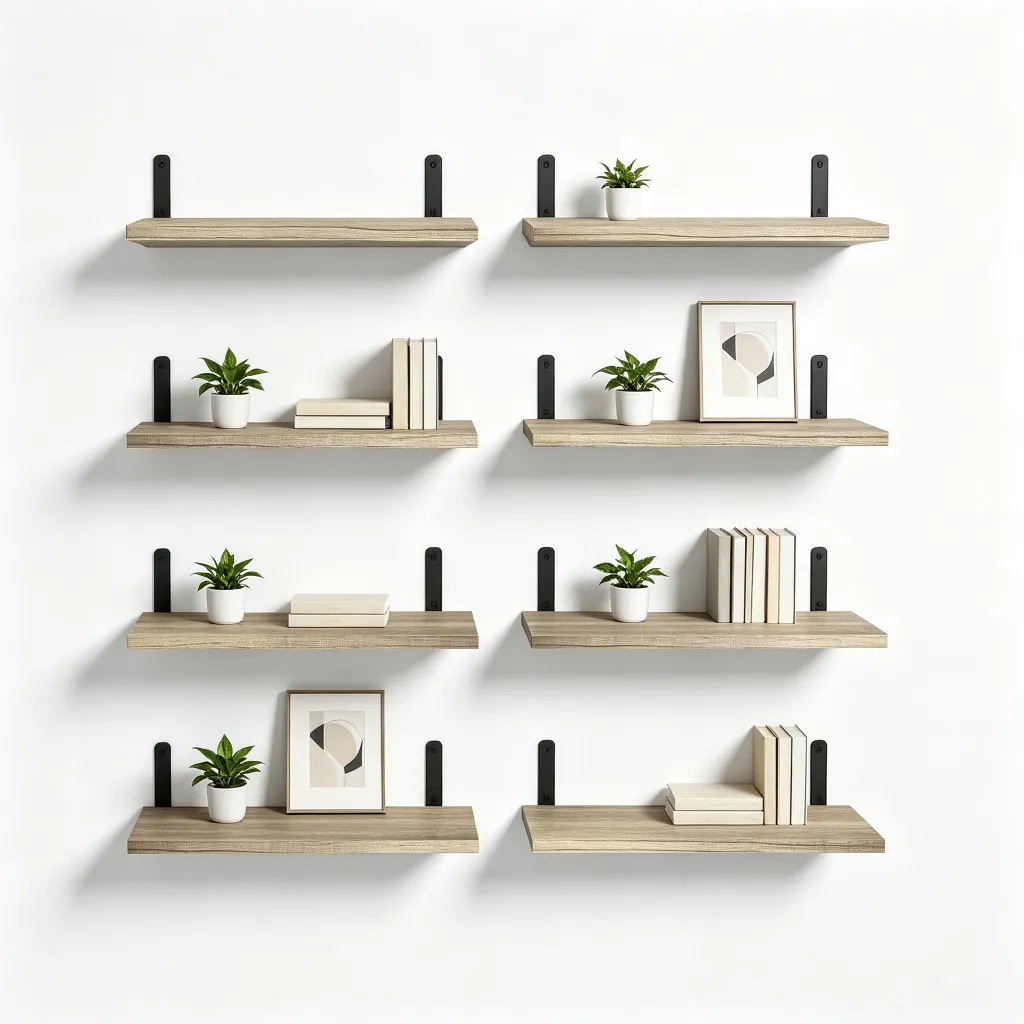
We have manufactured in Xianju, Zhejiang, since 2010 — 15+ years of export, 100+ people on site — and our solid-wood range is deliberately narrow: 24 SKUs, two species. Paulownia carries most of the range; pine carries the nursery bookshelf line. Paulownia is light and warp-resistant, and every board carries its own grain. The pine nursery shelves come with a hand-waxed finish. The full range is in our solid wood shelving collection.
Sizes run 13.8 in for the small sets, 15.7 in over the toilet, 16 in for the corner set of four, 16.5 in for the straight sets of two and eight, 16.8 in for the guardrail sets, and 16.9 in for the pine nursery bookshelves. The straight 2-piece boards are 16.5 in wide, 5.7 in deep, 0.6 in thick; the 8-piece set is 16.5 by 5.8 by 0.6 in; the nursery shelf is 16.9 by 4.5 in, 3.9 in high with its guard.
Finishes are Natural Carbonized, Dark Brown, Grey, Light Oak, White, Black, Black and Gold, and White and Gold. Carbonized deserves a sentence of its own: it is a heat-toned finish on paulownia, a darkening that comes from treating the board — not a different species. Buyers sometimes read “carbonized” as a timber name. It is not.
One clarification we make in every RFQ: oak and walnut appear on our site as finish colours on our engineered-wood line — the factory’s main line is engineered-wood floating shelves. We do not stock solid oak or solid walnut. If you need solid oak, say so at RFQ stage and we will price it as a case-by-case custom job, with its own MOQ and lead time. What we will not do is let a finish name do the work of a species name on an invoice.
No two boards match — that is the point, and the problem
Real grain means variation. Two paulownia boards from the same batch will not match exactly, and a set photographed from a single board will mislead the end customer who receives the other three. We sort and match boards inside each set so the tone stays in the same family, and we photograph the set, not a hero board. If your listing shows one board, your customer will compare their four against that one — and the one they compare against is the one they did not receive.
This is also where moisture earns its place. Wood moves after machining if it was not dried and conditioned properly — warp, cup, split. The moisture band buyers ask us about most often is 8–12% kiln-dried; treat that as the range buyers commonly ask for, not a number we print as our own measured value — there is no single safe percentage for every species and destination, and any factory that quotes you its own figure should be able to show you the readings behind it. Our longer treatment is in our moisture control for wall shelves post: the checks, not the claims.
Five questions to ask any supplier before you order 500
Ask these in the RFQ, not after the deposit. A factory that answers them cleanly is a factory that lives with the answers.
- What species, written on the invoice? Not “natural wood” — the species name. Our answer: solid paulownia, or solid pine on the nursery line, written as such.
- What finish, by code? A colour word drifts between batches; a finish code does not. Our answer: one of the eight finishes above, by name on the order.
- What moisture check do you run at inspection? Ask what range they check against, how they measure, and what happens to a board that fails. Our answer: we agree the target range and the measurement method with you at sampling stage, record readings across boards rather than one favourable reading, and boards outside the agreed range do not ship.
- Can I approve a sample board before mass production? Grain and finish are the two things a photo cannot settle. Our answer: yes — approve the sample board, and production matches the sample, not a catalogue photo. Our solid wood factory guide walks through the same approval logic in more detail.
- What load figure, and under what install? A headline number without a wall type is decoration. Our answer: the 2-piece paulownia set holds up to 40 lb per set, each shelf of the 8-piece set up to 20 lb — correctly installed on studs or a solid wall, with the brackets as supplied. Ask the same question of any other supplier and compare the conditions, not the numbers.
One more line for the order itself: our MOQ is 500 pcs per SKU per colour, standard lead time 2–4 weeks and custom orders 4–8 weeks — the same figures in our MOQ guide. Put them in your planning sheet before you ask for a price, not after.
Start with the board, not the phrase
If the phrase on your listing is “natural wood”, make sure the shelf behind it is the one your customer expects — same species, same construction, same finish, board after board. Send us your target sizes, finishes and quantities through the contact form and we will quote the combination — and send a sample board first, so you can check the grain, the finish and the bracket fit before you commit to 500 pcs.